
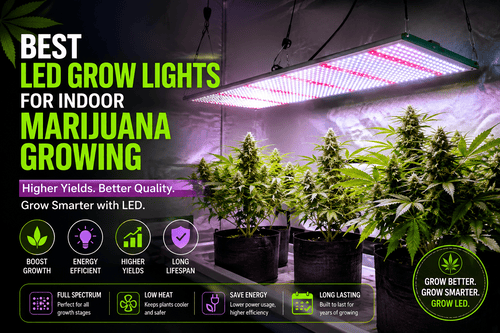
Your grow light decides more of your harvest than almost anything else you buy. Good soil helps, a nice tent helps, but if the light overhead is weak or the spectrum is off, your plants will stretch, stall, or finish with buds that feel airy instead of dense. That’s the part nobody tells you when you’re staring at fifty tabs of grow lights that all claim to be the best one.
I went through actual manufacturer specs, independent grow reports, and real wattage numbers instead of just trusting marketing pages. No guessing on coverage areas, no rounding up on efficiency claims.
This guide covers how LED grow lights actually work, what to look for before you buy one, and a breakdown of 20+ specific lights across every budget and room size, from a $100 light for a closet to a commercial fixture built for a 5×5 tent.
Grab a coffee and keep scrolling. By the end you’ll know exactly which light fits your space and your budget, no more tabs, no more guessing.
Quick answer: what’s the best LED grow light for indoor growing? There’s no single “best” light for everyone, it depends on your room size and budget. For most home growers in a 2×2 to 4×4 tent, a full-spectrum quantum board or bar-style light from Spider Farmer, AC Infinity, or HLG hits the best balance of price, coverage, and light quality. If you want our specific top picks by category, jump to How to Choose the Best LED Grow Light for 2026.
What Is an LED Grow Light?
An LED grow light is a fixture built to produce the specific light wavelengths plants use for photosynthesis, instead of the general-purpose white light a regular bulb puts out. Modern versions use diodes (usually Samsung, Osram, or a house brand) arranged on bars or boards, wired to a driver that controls power and dimming.
LED vs. Traditional Grow Lights
Older grow setups used HPS (high pressure sodium) or CFL bulbs. HPS puts out a lot of light but burns hot, eats electricity, and needs a ballast. CFLs are cheap but weak, fine for a single small plant and not much else. LEDs sit in between on price and beat both on efficiency, they turn more of the electricity they use into usable light instead of heat.
Why LEDs Are Popular for Indoor Growing
Growers switched to LED for three simple reasons: lower electric bills, less heat to manage, and fixtures that last years instead of needing bulb replacements every season. A quality LED can run for 50,000+ hours before its output noticeably drops, which is basically the entire lifespan of a home grow setup.
How Do LED Grow Lights Work?
How LEDs Produce Usable Light for Plants
Each diode on the board converts electricity directly into light at specific wavelengths, rather than burning a filament or gas. Manufacturers mix diodes (white, deep red, sometimes far-red or UV) to build a spectrum that matches what a plant’s leaves and flowers actually absorb.
Light Spectrum and Plant Growth
Plants mostly use blue light (around 400 to 500 nanometers) and red light (around 600 to 700 nanometers) for photosynthesis, with blue driving compact vegetative growth and red pushing flowering and stretch. Green light gets reflected more than absorbed, which is why plants look green in the first place, but a small amount still helps penetrate the canopy.
Role of PAR and PPFD
PAR (Photosynthetically Active Radiation) is the range of light wavelengths plants can actually use, roughly 400 to 700 nanometers. PPFD (Photosynthetic Photon Flux Density) measures how much of that light is actually landing on your plants at a given spot, in micromoles per square meter per second. A light can have a high total output and still deliver weak PPFD at the edges of your tent if the beam angle or hanging height is off, which is why coverage claims alone don’t tell the full story.
How Do LED Grow Lights Help With Indoor Marijuana Growing?
Vegetative Growth
A blue-heavy spectrum during veg keeps plants compact and encourages strong stem and leaf development instead of leggy stretch, which matters a lot in a height-limited tent.
Flowering
Switching to a red-heavy spectrum (or dialing up red-heavy diode channels on a light with independent control) signals the plant to put energy into bud development instead of foliage. Full-spectrum lights handle this without you swapping fixtures, since they already cover both ranges.
Energy Efficiency
LEDs convert a bigger share of electricity into usable light than HPS or CFL, which means lower running costs over a grow that can last three to four months from seed to harvest.
Heat Management
Less wasted energy means less waste heat, so your tent stays easier to keep in the ideal 70 to 85°F range without cranking the AC or running extra exhaust fans around the clock.
Consistent Light Exposure
Dimmable drivers let you hold a steady, even PPFD across the whole grow cycle instead of the light output drifting as a bulb ages, which keeps growth predictable from clone to harvest.
Why Choose Full-Spectrum LED Grow Lights?
What Full Spectrum Means
A full-spectrum LED mixes white, red, and often far-red or UV diodes to approximate the range of wavelengths plants would get from natural sunlight, instead of leaning hard into just one color band.
Benefits Throughout the Plant’s Growth Cycle
Because full spectrum covers both the blue range veg needs and the red range flowering needs, one light can run your plant from seedling to harvest without a fixture swap. Many full-spectrum lights also include a small amount of far-red, which some growers use to trigger faster flower transition.
Full Spectrum vs. Blurple/Limited-Spectrum Lights
Older “blurple” lights use only blue and red diodes, which looks purple to your eyes and can work, but it skips wavelengths that affect bud density and terpene development. Nearly every light in this guide is full spectrum for that reason, it’s simply the better standard at this point.
What Are the Benefits of Using LED Grow Lights?
- Lower energy consumption. LEDs typically use less wall power than HPS for a comparable light output, which adds up fast over a multi-month grow.
- Less heat. Cooler fixtures mean less strain on your ventilation and AC, especially in a small tent.
- Longer lifespan. Most quality LED drivers and diodes are rated for tens of thousands of hours before output drops meaningfully.
- Better light coverage. Bar-style and quantum board designs spread light more evenly across a canopy than a single central bulb.
- Adjustable spectrum and intensity on some models. Higher-end lights let you dial in veg and bloom channels separately instead of running one fixed spectrum.
- Lower operating costs. Between the electricity savings and not replacing bulbs, LEDs usually pay back their higher upfront cost within one to two grows.
What to Consider Before Buying an LED Grow Light
- Wattage and actual power draw. Ignore the “equivalent to a 1000W HPS” marketing number and look for the actual watts the fixture pulls from the wall, that’s the real cost and output driver.
- Grow room size. Measure your tent or space first. A light sized for 2×2 ft will leave a 4×4 tent dark at the corners.
- PPFD/PAR output. Check if the manufacturer publishes a PPFD map at your intended hanging height, not just a peak number.
- Light coverage. Manufacturers often list two coverage numbers, one for veg and a smaller one for flower, since flowering needs more intense light.
- Spectrum. Full spectrum is the safe default for cannabis unless you have a specific reason to want something narrower.
- Energy efficiency. Look for efficacy in micromoles per joule (µmol/J). Anything above 2.5 µmol/J is solid, above 3.0 µmol/J is excellent.
- Dimming and controls. A dimmable driver lets you match light intensity to plant age instead of running full blast from day one.
- Heat management. Passive (fanless) designs are quieter and simpler, but active cooling can push more light from a smaller footprint.
- Build quality. Aluminum housing, a name-brand driver (Meanwell, Sosen), and IP-rated water resistance all matter if you’re running humidity high for cloning or early veg.
- Warranty. Two to five years is standard among the brands in this guide, and a real warranty is a decent proxy for how much a company trusts its own hardware.
- Price and value. The cheapest light per watt isn’t always the cheapest light per gram of quality bud. Balance upfront cost against efficiency and coverage.
How Many Watts Do You Need for Your Grow Room?
Actual watts drawn (not the inflated “HPS equivalent” number) is the number that matters. As a simple starting point, most full-spectrum LEDs perform well in flower at around 32 to 50 actual watts per square foot of canopy.
| Grow space | Recommended actual wattage | Typical light class |
|---|---|---|
| 1×1 ft (single small plant) | 25 to 40W | Small clip-on or mini panel |
| 2×2 ft | 100 to 150W | Entry-level quantum board |
| 2×4 ft / 3×3 ft | 200 to 300W | Mid-size board or bar light |
| 4×4 ft | 400 to 600W | Full-size board or multi-bar fixture |
| 5×5 ft | 650 to 800W | Commercial bar fixture |
| 6×6 ft and up | 1000W+ | Commercial multi-bar system |
Watts alone don’t guarantee a good grow though. Two 400W lights from different brands can produce very different PPFD depending on diode quality, driver efficiency, and how the light is spread across the canopy. Use the wattage table to narrow your search, then check PPFD and coverage maps before you commit.
What Are PAR Values and Why Do They Matter?
PAR Explained Simply
PAR is the slice of the light spectrum, roughly 400 to 700 nanometers, that plants can actually use for photosynthesis. Light outside that range (like most infrared) doesn’t do much for growth, so PAR is a better measure of usefulness than total brightness.
PPFD vs. PAR
PAR describes which wavelengths count. PPFD measures how much of that usable light is actually hitting a specific point in your grow space. Think of PAR as the category and PPFD as the number that tells you if your plants are getting enough of it.
Why Manufacturers’ PAR Maps Matter
A PAR map shows PPFD readings across a grid at a set hanging height, usually the corners, edges, and center of the coverage area. A light with strong center PPFD but weak corner readings will grow uneven plants, dense in the middle and leggy at the edges. Always check the map, not just the headline PPFD number.
How to Compare Two Lights
Match hanging height and coverage area first, since PPFD changes with both. Then compare average PPFD across the whole canopy, not just the peak center reading, and check how evenly that number holds from center to edge.
How Do You Know If Your Plants Are Getting Enough Light?
PPFD/Light Intensity
Seedlings and clones do best around 200 to 400 µmol/m²/s. Vegetative plants want roughly 400 to 600. Flowering cannabis benefits from 600 to 900+ µmol/m²/s, with some high-light strains and setups pushing higher when paired with CO2 supplementation.
Coverage
Check that your light’s rated coverage actually matches your canopy size at flowering intensity, not just its larger veg-stage coverage number.
Plant Response
Healthy plants under adequate light show tight internode spacing (the gaps between leaf sets), sturdy stems, and leaves angled slightly upward toward the light.
Signs of Too Much or Too Little Light
Too little light causes stretching, thin stems, and pale, reaching growth. Too much light causes leaf bleaching, curling (“taco-ing”) at the edges, and canopy burn directly under the fixture.
Importance of Hanging Height
Raising or lowering your light changes PPFD a lot more than most people expect, since intensity drops fast with distance. Start at the manufacturer’s recommended height and adjust based on how the top leaves respond over the following few days.
20+ Best LED Grow Lights for 2026
Prices below are approximate ranges pulled from current grow-light roundups and retailer listings, not live scraped prices, since prices and stock shift often. Check the Amazon listing for the exact current price and rating before buying.
Quick Comparison Table
| Product | Actual Wattage | Coverage (Flower) | Spectrum | Best For | Price Range |
|---|---|---|---|---|---|
| Spider Farmer SF1000 | 100W | 2×2 ft | Full spectrum | Beginners | Check on Amazon |
| Mars Hydro TS 1000 | 150W | 2×2 to 3×3 ft | Full spectrum | Budget pick | Check on Amazon |
| VIVOSUN VS1000E | ~100W | 2×2 to 3×3 ft | Full spectrum | Budget small space | Check on Amazon |
| ViparSpectra XS1500 Pro | 150W | 2×2 ft | Full spectrum | Small grow spaces | Check on Amazon |
| AC Infinity IONBOARD S22 | ~100 to 115W | 2×2 to 2×3 ft | Full spectrum | Humid environments | Check on Amazon |
| HLG 100 V2 R-Spec | 95W | 2×2 ft | Full spectrum, R-Spec | High-potency focus | Check on Amazon |
| Spider Farmer SF2000 | 200W | 2×4 or 3×3 ft | Full spectrum | Small-mid tents | Check on Amazon |
| Mars Hydro TSL2000 | 300W | Roughly 2×4 ft | Full spectrum | Budget large coverage | Check on Amazon |
| AC Infinity IONFRAME EVO4 | 300W | 3×3 ft | Full spectrum | Ecosystem integration | Check on Amazon |
| NextLight 150H | 150W | 2×2 flower / 3×3 veg | Full spectrum | Premium small space | Check on Amazon |
| Spider Farmer SF4000 | 450W | 4×4 ft | Full spectrum | Large room value | Check on Amazon |
| Spider Farmer SE5000 | 480W | 4×4 ft | Full spectrum | Energy efficiency | Check on Amazon |
| AC Infinity IONFRAME EVO6 | 500W | 4×4 ft | Full spectrum | Most popular 4×4 | Check on Amazon |
| Photontek X 465W Pro | 465W | 4×4 ft | Full spectrum | Premium diodes | Check on Amazon |
| California Lightworks SolarSystem 550 | ~400W | 4×4 ft | Full spectrum, RGB channels | Full-spectrum tuning | Check on Amazon |
| Spider Farmer SE7000 | 730W | 5×5 ft | Full spectrum | Large room value | Check on Amazon |
| AC Infinity IONFRAME EVO10 | 1000W | 5×5 ft | Full spectrum | Large commercial | Check on Amazon |
| Phlizon FD9600 | 1000W | 4×4 to 7×7 ft | Full spectrum, UV/IR | Budget commercial | Check on Amazon |
| Growers Choice ROI-E720 | 720W | 5×5 ft | Full spectrum | Large grow rooms | Check on Amazon |
| HLG Scorpion Diablo | 630W | 5×5 ft+ | Full spectrum | Premium option | Check on Amazon |
Detailed LED Grow Light Reviews
1. Spider Farmer SF1000
Best for: Beginners setting up their first tent
Power: 100W actual draw, fully dimmable
Coverage: 2×2 ft flower, 2.5×2.5 ft veg
Spectrum: Full spectrum white with added red
Key Features
- Samsung diodes on a quantum board layout
- Meanwell dimmable driver
- Quiet, fanless (passive cooled) design
- Daisy-chain capable if you add a second unit later
Pros
- Simple to set up with no learning curve
- Reliable output for the price
- Runs cool enough for a small closet grow
Cons
- Coverage is tight for anything bigger than a 2×2 tent
- No app or smart controls
Our Verdict
The SF1000 is the light I’d point a first-time grower toward. It does one job, lighting a 2×2 tent well, and does it without extra features you’d have to learn. Skip it if you’re planning to scale past a single small tent soon, since you’ll outgrow it fast.
2. Mars Hydro TS 1000
Best for: Budget-conscious first-time buyers Power: 150W actual draw, dimmable Coverage: 2×2 ft flower, up to 3×3 ft veg Spectrum: Full spectrum with a patented reflector design
Key Features
- Reflector cups behind each diode to reduce wasted light
- Dimmable driver knob, no app required
- Aluminum housing for heat dissipation
- Simple hanging kit included
Pros
- One of the lowest entry prices in this guide
- Reflector design pushes more light down instead of sideways
- Straightforward, no assembly headaches
Cons
- Edges of the housing can be sharp, handle carefully during setup
- Basic dimmer, no scheduling or app control
Our Verdict
If price is the deciding factor, the TS 1000 is hard to beat for a 2×2 space. It’s not fancy, it’s a dimmable panel that does the job. Buyers who want smart controls or app scheduling should look elsewhere.
3. VIVOSUN VS1000E
Best for: Budget shoppers who want a second reliable brand option Power: Roughly 100W class, dimmable Coverage: 2×2 to 3×3 ft Spectrum: Full spectrum, “sunlike” diode mix
Key Features
- Full-spectrum diode layout for seedling through bloom
- Dimmable driver
- Compact, lightweight housing
- Compatible with VIVOSUN’s GrowHub controller ecosystem for scheduling
Pros
- Competitive pricing against Mars Hydro and Spider Farmer
- Optional smart controller add-on if you want scheduling later
- Widely available with accessible replacement parts
Cons
- Coverage claims run a little generous at the veg-stage end
- Fewer independent long-term grow reports than Spider Farmer or Mars Hydro
Our Verdict
The VS1000E is a solid third option if you’ve already compared Mars Hydro and Spider Farmer and want to check pricing across brands. It performs similarly at this wattage class. Worth it if you plan to build out VIVOSUN’s connected ecosystem later, otherwise pick whichever of the three is cheapest that week.
4. ViparSpectra XS1500 Pro
Best for: Small grow spaces on a budget Power: 150W actual draw Coverage: 2×2 ft, extending to 3×3 ft at lower intensity Spectrum: Full spectrum white
Key Features
- New-generation lens design for better light spread
- Dimming knob with daisy-chain support
- Passive cooling, no fan noise
- Compact footprint for tight closets
Pros
- Strong PPFD for its price point in a 2×2 footprint
- Daisy chain support if you expand later
- Quiet operation
Cons
- Coverage drops off noticeably past 2×2 ft
- Basic build compared to quantum board competitors
Our Verdict
This is a close competitor to the SF1000 and TS 1000 in the same price bracket, and a fine pick if you find it cheaper on a given week. The lens design gives it a slight edge in light spread for a small tent specifically.
5. AC Infinity IONBOARD S22
Best for: Growers dealing with high humidity during cloning or early veg Power: Around 100 to 115W depending on the spec sheet you check Coverage: 2×2 to 2×3 ft Spectrum: Full spectrum with Samsung LM301H diodes
Key Features
- Moisture-resistant driver built for humid tents
- Fanless, passive-cooled design
- Deeper light penetration claimed from diode spacing
- Compact board footprint
Pros
- Handles humid propagation setups better than most budget boards
- Quiet, no moving parts to fail
- Good build quality for the price tier
Cons
- Wattage figures vary slightly between AC Infinity’s own materials, confirm current specs before buying
- Coverage is on the smaller side of this price bracket
Our Verdict
If you run a humidifier hard for clones or seedlings, the S22’s moisture resistance is a real advantage over standard boards. For a dry tent, the SF1000 or TS 1000 will get you similar light for less.
6. HLG 100 V2 R-Spec
Best for: Growers chasing potency and resin production in a small space Power: 95W, non-dimmable on the base V2 model Coverage: 2×2 ft flower, 2.5×2.5 ft veg Spectrum: Full spectrum with an R-Spec diode mix tuned for flowering response
Key Features
- Samsung LM301B diodes on a quantum board
- R-Spec spectrum specifically marketed for potency and resin
- Meanwell driver, known for reliability
- Passive cooled
Pros
- Strong reputation among growers for bud quality over raw yield
- Reliable driver brand
- Simple, no-frills operation
Cons
- No onboard dimming on the base V2, intensity is fixed
- Premium price for a 2×2-class light
Our Verdict
HLG built its name on quality over flash, and the 100 V2 R-Spec fits that reputation in a small footprint. It costs more than the SF1000 or TS 1000 for similar coverage, but growers chasing potency over yield tend to prefer the R-Spec tuning.
7. Spider Farmer SF2000
Best for: Growers stepping up from a 2×2 to a 2×4 or 3×3 tent Power: 200W actual draw, dimmable Coverage: 2×4 ft or 3×3 ft flower Spectrum: Full spectrum
Key Features
- Samsung diode quantum board
- Dimmable Meanwell driver
- Rectangular light spread suited to 2×4 tents
- Daisy-chain capable
Pros
- Proven track record, one of Spider Farmer’s most reviewed lights
- Good coverage-to-price ratio for a 3×3 space
- Runs cool enough for passive cooling
Cons
- Not quite enough for a full 4×4 tent at flowering intensity
- No app control
Our Verdict
The SF2000 is the natural next step up from the SF1000 once you outgrow a 2×2 tent. It’s one of the most consistently recommended mid-size lights across independent grow reports, and for good reason.
8. Mars Hydro TSL2000
Best for: Budget growers who want more coverage than a standard 2×2 light without paying flagship prices Power: 300W actual draw Coverage: Roughly 2×4 ft, with Mars Hydro citing up to 5×3 ft at lower intensity for veg Spectrum: Full spectrum with reflector cups
Key Features
- Reflector-backed diodes for reduced light waste
- Dimmable driver with daisy-chain support
- Larger coverage footprint than the TS 1000
- Aluminum frame construction
Pros
- More coverage per dollar than most lights in its price range
- Reflector design improves light efficiency
- Good option for stretching a budget across a bigger tent
Cons
- Sharp aluminum edges on the housing, handle with care during install
- Flower-stage coverage is smaller than the veg-stage number suggests, plan for 2×4 ft at bloom intensity
Our Verdict
Mars Hydro built this one to be the “more light for less money” option, and it mostly delivers, as long as you go in expecting 2×4 ft coverage at flowering strength rather than the bigger veg-stage figure on the box.
9. AC Infinity IONFRAME EVO4
Best for: Growers already using AC Infinity’s fan and controller ecosystem Power: 300W actual draw Coverage: Roughly 3×3 ft (90x90cm) Spectrum: Full spectrum, Samsung LM301H EVO diodes
Key Features
- 896 diodes across a bar-style layout
- Schedule controller included for automated dimming and timing
- Integrates with AC Infinity’s UIS smart ecosystem (fans, sensors)
- Bar design for more even canopy coverage than a single board
Pros
- Automation works well if you already own AC Infinity fans or controllers
- Even light spread from the bar layout
- High-efficacy EVO diodes
Cons
- Coverage is closer to 3×3 ft than a full 4×4, size your tent accordingly
- Costs more than a comparable Spider Farmer board
Our Verdict
This one makes the most sense as part of a full AC Infinity setup rather than as a standalone light. If you’re not already in that ecosystem, the SF2000 covers similar ground for less.
10. NextLight 150H
Best for: Growers who want a premium small-space light and don’t mind paying for it Power: 150W actual draw Coverage: 2×2 ft flower, 3×3 ft veg Spectrum: Full spectrum, Samsung diodes
Key Features
- Fully passive cooled with no fan
- 5-year warranty, among the longest in this guide
- Compact, well-built aluminum housing
- Designed and assembled with commercial-grade components
Pros
- Excellent build quality and warranty support
- Silent operation
- Strong, even light spread for its size
Cons
- Premium price for the coverage you get
- Overkill if you just want the cheapest working option
Our Verdict
The 150H is what you buy when you want a small light you won’t think about again for five years. It costs more than the SF1000 or TS 1000 for similar coverage, and the warranty and build quality are the reason why.
11. Spider Farmer SF4000
Best for: Growers with a full 4×4 tent wanting the best value at that size Power: 450W actual draw, dimmable Coverage: 4×4 ft flower, 5×5 ft veg Spectrum: Full spectrum, Samsung LM301H EVO diodes
Key Features
- Multi-bar quantum board layout for even canopy coverage
- WiFi and Bluetooth control through the Spider Farmer app
- Dimmable Meanwell-class driver
- Daisy-chain capable for scaling to multiple tents
Pros
- Strong PPFD across the full 4×4 footprint, not just the center
- App control adds real convenience for scheduling and dimming
- Good price relative to AC Infinity’s equivalent EVO6
Cons
- Needs real exhaust to keep a 4×4 tent in the 75 to 85°F range at this wattage
- App is a nice-to-have, not essential, so don’t pay extra just to get it
Our Verdict
This is the light most reviewers point to as the default choice for a 4×4 tent. It draws real power and needs proper ventilation, but the coverage and even light spread justify the step up from the SF2000.
12. Spider Farmer SE5000
Best for: Growers who want the most light per watt in a 4×4 footprint Power: 480W actual draw Coverage: 4×4 ft flower Spectrum: Full spectrum, high-efficacy Samsung LM301H EVO diodes
Key Features
- Multi-bar design tuned for higher efficacy than the standard SF4000
- WiFi and Bluetooth app control
- Dimmable driver
- Detachable bars for easier installation in tight tents
Pros
- Best efficiency (µmol/J) in Spider Farmer’s 4×4 lineup
- Lower running cost than the SF4000 for similar light output
- Detachable design makes setup easier in a built tent
Cons
- Costs more upfront than the standard SF4000
- Efficiency gains matter most if you’re running the light for months at a time, less so for a single quick grow
Our Verdict
If you’re going to run this light for years across multiple grows, the SE5000’s efficiency premium pays for itself in lower electric bills. For a one-off grow, the cheaper SF4000 gets you nearly the same result.
13. AC Infinity IONFRAME EVO6
Best for: The most popular all-around 4×4 tent light right now Power: 500W actual draw Coverage: 4×4 ft flower Spectrum: Full spectrum, Samsung LM301H EVO diodes
Key Features
- 1,680 diodes across a multi-bar frame
- Schedule controller for automated dimming and sunrise/sunset ramping
- Integrates with AC Infinity’s broader UIS ecosystem
- High PPFD reported up to 1,991 µmol/m²/s at close range
Pros
- Frequently cited as the top overall pick for a 4×4 tent
- Automation and ecosystem integration are genuinely useful, not just marketing
- Strong, even PPFD across the canopy
Cons
- Premium pricing compared to the Spider Farmer SF4000
- Full ecosystem value depends on owning other AC Infinity gear
Our Verdict
If budget isn’t the deciding factor, this is the 4×4 light most current roundups point to first. It costs more than the SF4000, and for most growers that gap is worth it for the automation and even coverage alone.
14. Photontek X 465W Pro
Best for: Growers who want Osram diodes instead of the more common Samsung boards Power: 465W actual draw Coverage: 4×4 ft Spectrum: Full spectrum, Osram diodes
Key Features
- Osram diode set, an alternative to the Samsung diodes most competitors use
- Daisy-chain dimming support
- Bar-style commercial layout
- Built for consistent output at scale
Pros
- Osram diodes are well regarded for efficiency and longevity
- Daisy chaining makes multi-light rooms simpler to wire
- Commercial-grade build quality
Cons
- Less brand recognition among home growers than Spider Farmer or AC Infinity
- Pricing sits at the higher end for a 4×4-class light
Our Verdict
Worth considering if you specifically want to compare Osram diodes against the Samsung-based competition, or if you’re planning a multi-light commercial-style room where daisy chaining matters. For a single home tent, the SF4000 or EVO6 are simpler choices.
15. California Lightworks SolarSystem 550
Best for: Growers who want independent spectrum tuning instead of a fixed full-spectrum mix Power: Around 400W actual draw. The “550” in the name refers to its HPS-equivalent output class, not literal wall wattage, worth knowing before you compare it on a watts-per-dollar basis Coverage: 4×4 ft Spectrum: Full spectrum with independent RGB channel control
Key Features
- Separate control over red, blue, and white channels instead of one fixed mix
- Lets you shift spectrum manually between veg and flower stages
- Solid aluminum housing built for long-term commercial use
- Established brand with a long track record in horticultural lighting
Pros
- Real spectrum tuning, not just a marketing label
- Useful if you want to experiment with spectrum shifts through the grow cycle
- Durable, well-built fixture
Cons
- Actual power draw runs lower than the “550” name implies, confirm the real spec sheet before comparing wattage-per-dollar to other lights
- Manual channel tuning has a learning curve for new growers
Our Verdict
This is the light for someone who actually wants to experiment with spectrum ratios instead of trusting a fixed full-spectrum blend. New growers who just want a “set it and forget it” light should look at the SF4000 or EVO6 instead.
16. Spider Farmer SE7000
Best for: Growers scaling up to a 5×5 tent without jumping to full commercial pricing Power: 730W actual draw Coverage: 5×5 ft flower Spectrum: Full spectrum, Samsung LM301H EVO diodes
Key Features
- Multi-bar, detachable design for easier install in a built tent
- WiFi and Bluetooth app control
- Dimmable driver
- Even PPFD spread across a full 5×5 footprint
Pros
- Best value among 5×5-class lights in this guide
- App control and dimming match the smaller SF-series lights
- Detachable bars simplify setup in a finished tent
Cons
- Draws serious power, plan your circuit and ventilation accordingly
- Less commercial-grade certification than the Growers Choice or HLG options at this size
Our Verdict
For a home grower stepping up to 5×5, this is the value pick. It costs noticeably less than the Growers Choice ROI-E720 or HLG Scorpion Diablo while covering the same footprint.
17. AC Infinity IONFRAME EVO10
Best for: Large commercial-style rooms needing a single high-output fixture Power: 1000W actual draw Coverage: 5×5 ft Spectrum: Full spectrum, Samsung LM301H and LM301B EVO diodes
Key Features
- Passive cooling despite the high wattage, no fan to fail
- Schedule controller included for automated dimming
- UIS ecosystem integration for room-wide automation
- High-efficacy EVO diode mix
Pros
- Passive cooling at 1000W is a genuine engineering advantage, less to maintain
- Strong efficacy for a commercial-class fixture
- Automation scales well across multiple lights in a bigger room
Cons
- High upfront cost
- Overkill for anyone not running at least a 5×5 space
Our Verdict
This is built for growers running a serious room, not a hobby tent. If you’re at that scale, the passive cooling and automation are worth the price. If you’re still in a 4×4, the EVO6 or SF4000 make more sense.
18. Phlizon FD9600
Best for: Budget-focused growers who need serious wattage without the premium-brand price tag Power: 1000W actual draw Coverage: 4×4 ft flower up to 7×7 ft veg Spectrum: Full spectrum with added UV and IR diodes
Key Features
- Foldable frame for easier shipping and tent installation
- Daisy-chain dimming
- UV and IR diodes included alongside the core full spectrum
- Brand-name driver for reliability at this price
Pros
- Lowest cost per watt among the high-wattage lights in this guide
- Foldable design makes it easier to get into a built tent
- UV and IR add flexibility most budget lights skip
Cons
- Less established brand reputation than Spider Farmer, AC Infinity, or HLG at this wattage class
- Coverage claims at the 7×7 ft end apply to low-intensity veg only, not flowering
Our Verdict
If you need 1000W-class coverage and the AC Infinity EVO10 is out of budget, this is the realistic alternative. Just size your expectations to 4×4 or 5×5 at flowering intensity, not the largest coverage number on the listing.
19. Growers Choice ROI-E720
Best for: Large grow rooms wanting a commercial-grade bar fixture Power: 720W actual draw Coverage: 5×5 ft Spectrum: Full spectrum
Key Features
- Commercial bar fixture design
- Daisy-chain dimming across multiple units
- Built for licensed facility and serious home-grower use
- Strong, consistent PPFD across the full 5×5 footprint
Pros
- Commercial build quality most home-grade lights don’t match
- Daisy chaining makes multi-fixture rooms simple to wire and dim together
- Even coverage across the whole 5×5 area, not just the center
Cons
- Priced above the Spider Farmer SE7000 for similar coverage
- More fixture than most single-tent home growers actually need
Our Verdict
This is the light for someone thinking beyond a single tent toward a real grow room. If you’re daisy-chaining multiple fixtures, the commercial build quality and dimming compatibility justify the price over the SE7000.
20. HLG Scorpion Diablo
Best for: Growers who want the most established premium option in this guide Power: 630W actual draw Coverage: 5×5 ft and larger Spectrum: Full spectrum, Samsung LM301H diodes
Key Features
- Meanwell driver, the industry standard for reliability
- ETL/UL certified build
- Inventronics components in some driver configurations
- Long-standing reputation among commercial and serious home growers
Pros
- HLG’s reputation for build quality and consistency is well earned
- Certifications matter if you’re running this in a space with insurance or code requirements
- Strong, well-documented performance across independent grow reports
Cons
- Highest price in this guide by a real margin
- Two similarly named HLG products exist (Diablo and the newer Diablo X), double-check you’re ordering the exact model you compared
Our Verdict
This is the premium pick for growers who’ve already run cheaper lights and want to step up to what HLG considers its flagship. It’s not the light to start with as a beginner, it’s the light you buy once you know exactly what you want.
How to Choose the Best LED Grow Light for 2026
Instead of repeating the buying guide, here’s a direct recommendation for each type of buyer.
Best for beginners: Spider Farmer SF1000. It’s simple, well documented, and hard to mess up on your first grow.
Best budget option: Mars Hydro TS 1000. The lowest realistic entry price for a light that actually performs in a 2×2 tent.
Best for small grow spaces: ViparSpectra XS1500 Pro. Strong PPFD in a tight 2×2 footprint at a fair price.
Best for large grow rooms: Growers Choice ROI-E720. Commercial build quality and daisy-chain dimming for anyone running more than one fixture.
Best full-spectrum option: California Lightworks SolarSystem 550. Independent channel control gives you real spectrum tuning, not just a fixed blend.
Best energy-efficient option: Spider Farmer SE5000. The highest efficacy in Spider Farmer’s 4×4 lineup, which matters most if you’re running the light for years.
Best premium option: HLG Scorpion Diablo. The most established high-end name in this guide, with certifications and a track record to match the price.
How to Set Up Your Grow Room With LED Lights
Get Your Grow Room Kit Ready
A grow light is one piece of a working setup. Before you flip anything on, make sure you also have:
- LED grow light, sized to your actual tent dimensions at flowering intensity, not the largest coverage number on the box
- Grow tent or dedicated room, sealed enough to control light leaks and airflow
- Ventilation, an intake and exhaust path so hot air actually leaves the space
- Fans, both an exhaust fan for the tent and a small oscillating fan to move air across the canopy
- Timer or controller, to keep your light cycle consistent day to day, since inconsistent timing stresses plants
- Thermometer and hygrometer, so you’re adjusting based on real temperature and humidity readings, not guesses
- Reflective surfaces, mylar or a reflective tent interior to bounce light back onto the plant instead of losing it to the walls
- Mounting equipment, adjustable rope ratchets or hangers so you can raise the light as your plants grow
Get these dialed in together, and the light you picked from this list will actually perform the way its spec sheet promises.
LED Grow Lights: Frequently Asked Questions
What is the best LED grow light for indoor marijuana growing? It depends on your room size and budget. For most 2×2 to 4×4 home setups, a full-spectrum board or bar light from Spider Farmer, AC Infinity, or HLG offers the best mix of coverage, efficiency, and price.
Are full-spectrum LED grow lights better? Yes, for cannabis specifically. Full spectrum covers both the blue range veg needs and the red range flowering needs, so one light can run the whole grow cycle without swapping fixtures.
How many watts do I need for an LED grow light? As a rough guide, plan on 32 to 50 actual watts per square foot of canopy at flowering intensity. Check the wattage table earlier in this guide for specific room sizes.
How far should an LED grow light be from plants? It depends on the fixture’s output, but most full-spectrum LEDs run 12 to 24 inches above the canopy during flowering, and a bit higher during veg. Always start at the manufacturer’s recommended height and adjust based on how the plant responds.
Are LED grow lights energy efficient? Yes, especially compared to HPS. Quality LEDs convert more electricity into usable light instead of wasted heat, which lowers running costs over a multi-month grow.
Do LED grow lights produce heat? They produce less heat than HPS or CFL, but they’re not heat-free, especially at higher wattages. A 500W-plus fixture still needs real ventilation to keep a tent in a healthy temperature range.
How long do LED grow lights last? Most quality diodes and drivers are rated for 50,000 or more hours before output meaningfully drops, which covers years of regular grows.
Can one LED grow light be used for the entire growth cycle? Yes, if it’s full spectrum. That’s the main advantage over older single-spectrum setups that needed a light swap between veg and flower.
Do LED grow lights need a ballast? No. Ballasts are an HPS requirement. LEDs use a driver instead, which is smaller, more efficient, and built into or alongside the fixture.
How do I know if my plants are getting enough light? Check for tight internode spacing, sturdy stems, and leaves angled slightly toward the light. Stretching and pale growth mean too little light, while bleaching or leaf curling under the fixture means too much.
Final Verdict: Which LED Grow Light Should You Choose?
If you’re just starting out, the Spider Farmer SF1000 or Mars Hydro TS 1000 will get a 2×2 tent running without overspending on features you don’t need yet. Growing in a 4×4 space, the Spider Farmer SF4000 and AC Infinity IONFRAME EVO6 are the two lights most current grow reports point to first, with the SF4000 winning on price and the EVO6 winning on automation. Scaling up to 5×5 or a real grow room, the Growers Choice ROI-E720 and HLG Scorpion Diablo bring commercial-grade build quality, at a real price jump over the Spider Farmer SE7000.
There’s no universal “best” light here, only the best light for your room size, your budget, and how long you plan to keep growing. Match the wattage and coverage to your actual tent, not the biggest number on the page, and any light in this guide will get your plants to harvest.